🐜
Insects
Division of labour, shared defence, collective construction.
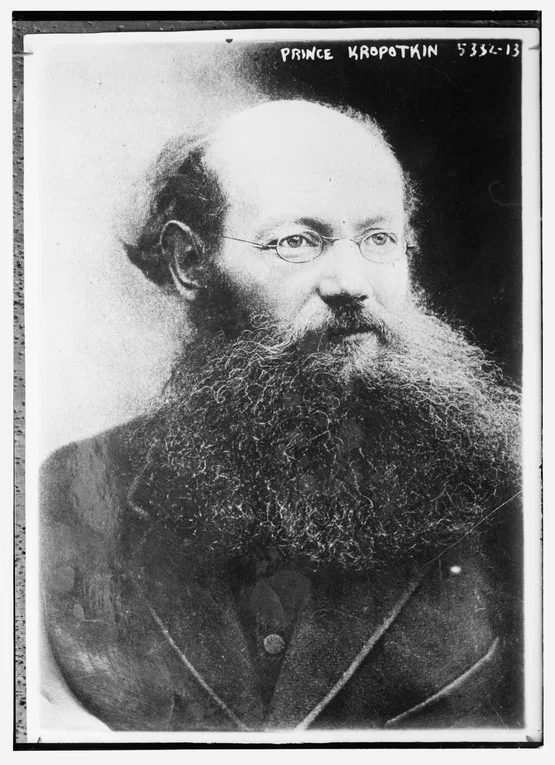
Kropotkin did not argue that cooperation mattered because it occupied a long chapter of history. He argued that cooperation is itself one of the forces by which life survives and evolves.
Duration describes a timeline. Selection explains survival.
In Mutual Aid: A Factor of Evolution, Kropotkin examines cooperation across animal life and human organization. His subject is not nostalgia. It is adaptive function.
Animals gather, warn, defend, migrate, rear young and secure food together because those behaviours improve the chances of survival. Human societies build kinship, commons, guilds, neighbourhoods and voluntary associations for the same structural reason: isolation is expensive, while coordinated life distributes risk.
The point is not that competition disappears. The point is that the popular caricature of evolution as an endless knife fight leaves out an equally real force: organisms survive through relationships.
From colony to commons, survival learns to organize itself.
Division of labour, shared defence, collective construction.
Flocking, alarm calls, migration and coordinated feeding.
Group protection, cooperative hunting and care of young.
Commons, shared labour, reciprocity and local protection.
Guilds, unions, cooperatives and voluntary networks.
Mutual aid is not evidence that history once behaved better. It is evidence that life repeatedly discovers cooperation because cooperation works.
Longevity may show that a strategy endured. Kropotkin’s deeper claim is that mutual aid endures because, under real conditions of danger and scarcity, it can preserve life better than isolated struggle.
Read Mutual AidKropotkin gave the why. Proudhon drew the shape.
Pierre-Joseph Proudhon, 1851 — the refusal of rule and the four-part Yes beneath it: self-direction, mutual aid, free contract, federation.
Read The Federation ↗ Primary textKropotkin’s full study of cooperation across animal and human life, free at Project Gutenberg.
Read the source ↗